Have you heard of the ‘third teacher’ before? They sit behind the teacher and family in terms of impact on children’s learning. They have the power to bring comfort to or invoke stress in children. The ‘third teacher’ can encourage or discourage a child from engaging. Yes, the ‘third teacher’ is the learning environment. Named so, because of its importance to early childhood education (ECE).
The learning environment is wide-ranging. It includes both indoor and outdoor spaces, as well as the design, layout and organisation of these.
Temporal and social elements are also part of the learning environment. For example, allocating time and space for active and quiet play can help to establish a routine.
Early childhood educators can offer diverse and meaningful experiences for children by altering and tailoring the learning environment.
The learning environment in the Early Years Learning Framework and National Quality Standard
Both the Early Years Learning Framework (EYLF) and National Quality Standard (NQS) call for the environment to promote children’s well-being and support their creativity and confidence.
The EYLF is the curriculum framework for ECE in Australia. The latest version says:
Environments that support learning are vibrant and flexible spaces that are responsive to the strengths, culture, languages, interests and capabilities of each child, and reflect aspects of the local community.”
Australian Government Department of Education, 2022, p 23
Therefore, the learning environment is a way to engage in cultural responsiveness and foster a sense of belonging in children.
The National Quality Standard (NQS) also highlights the importance of the learning environment. The environment is present in several of its Quality Areas:
- Quality Area 1 – Educational program and practice
- Quality Area 2 – Children’s health and safety
- Quality Area 3 – Physical Environment
For example, Quality Area 1 calls for the program, including routines, to be organised to maximise learning opportunities.
The NQS is the benchmark for the quality of ECE in Australia. It outlines the standards that early childhood settings are assessed against.
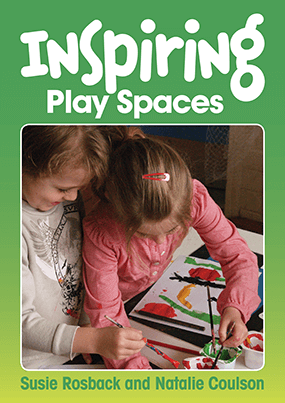
Our Inspiring Play Spaces early childhood education resource assists you in creating play spaces that align with the EYLF and NQS.

The importance of a learning environment
Ensuring children’s health and safety is the obvious reason why learning environments are crucial. Buildings, fixtures and fittings all need to be fit for purpose to ensure children are protected from harm.
Part of being fit for purpose includes the spaces being accessible by every child. And this extends to creating an inclusive environment where all children can participate and engage. For example, are there enough materials and resources for each child to use?
Secondly, the learning environment enables positive relationships and effective communication. Open spaces allow for interaction, inclusivity and engagement. And in the same way, having different means of communication within a space (for example, verbal, written or visual) will help children to express themselves.
Outdoor spaces in a learning environment
Outdoor spaces are part of the learning environment. They offer an array of physical activities and learning experiences, which are not available or limited indoors.
- Open-ended play and interactions – There are more opportunities for open-ended play in the outdoors, inviting children to create, discover and explore. When children are not confined by a time restriction or desired outcome, they feel free to take risks and act spontaneously.
- Mental and physical well-being – Simply just being outside in the natural environment improves well-being – not just in children, but adults too. If you are not convinced, Google the Japanese practice of “forest bathing” (or shinrin-yoku). It also helps children’s physical development through jumping, running and climbing. Outdoor activities like this build strength and improve gross motor skills.
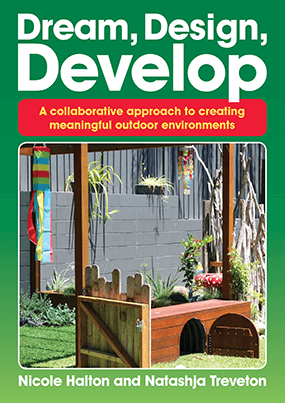
- Connection with the environment – As Nicola Halton and Natashja Treventon explain in Dream, Design, Develop, “There is an international push for children to ‘save the planet’, yet unless a strong connection to the natural world is fostered in the early years, what incentive is there to protect it?” Outdoor spaces help children to learn about the environment and encourage them to take responsibility for it.

The best way to illustrate why outdoor learning environments are important is to finish with another quote from one of our ECE resources. In Dream, Design, Develop it says:
We ask educators to recall and share memories of childhood play, and most common among the memories shared are nostalgic recollections of uninterrupted (and often unsupervised) outdoor play.
References
Australian Government Department of Education (2022). Belonging, Being and Becoming: The Early Years Learning Framework for Australia (V2.0). https://www.acecqa.gov.au/sites/default/files/2023-01/EYLF-2022-V2.0.pdf