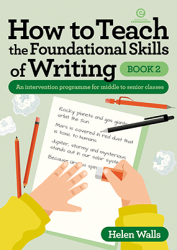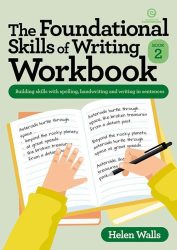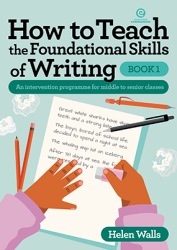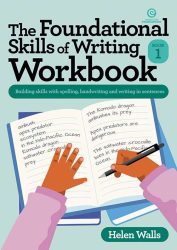
Grab a coffee and join Helen Walls as she walks us through the thinking behind her upcoming four-book writing intervention series. With Book 1 already in classrooms, Book 2 on the way and two more in development, Helen shares how each title is designed to rebuild the essential foundations many older students have missed. From spelling and handwriting to sentence construction and fast, effective feedback, she explains the practical, research-driven strategies teachers can use straight away – and why these resources are set to make a meaningful difference.
Tell us about the new writing intervention resources you are currently writing for teachers
My plan for the Foundation Skills Writing Intervention (FSWI) programme is to cover the full 40 weeks of the school year. The literacy intervention books I am writing will address different and more complex spelling patterns from my other resources.
- Currently available, Book 1 of How to Teach the Foundational Skills of Writing, and the accompanying workbook teach short vowel and long vowel spellings, as well as some consonant digraphs and relevant spelling rules.
- Soon to be published, Book 2 and its workbook address other vowel spellings, including diphthongs and r-controlled vowels.
- This will be followed by Book 3 which will revise long vowels – working slowly through common and less common spelling possibilities.
- Lastly, Book 4 will address other unusual patterns – the ou in rough, tough, touch; silent letters in words like the k in know, the b in lamb; more advanced rules for plurals and so on.
What problem are you trying to address for teachers?
Over recent decades, the significance of the technical skills of writing – handwriting, spelling and writing in sentences – has been downplayed. This means that some junior teachers did not prioritise the teaching of such skills, so that now there are many students in middle and senior classes who still struggle with them.
When students struggle with the foundations, this holds them back considerably – due to working memory limitations. When students must consciously think about which way a letter goes, how to spell common words, or where to put the capital letter and full stop – this prevents them from thinking about other aspects of writing. They often waste years in writing classrooms, unable to focus on the year level-appropriate goal their teacher is trying to teach them.
How will these books support teachers to intervene successfully?
The only way to remedy our current situation is to equip these older struggling students with the foundational skills they should have acquired as five and six-year-olds. This can be a daunting task for teachers, especially because these students often lack the confidence to write – they can be reluctant to even pick up a pencil.
In the FSWI programme, we will provide teachers with all the knowledge, all the planning, and all the resources they need to intervene and make a difference for these most vulnerable writers. All the methods and lessons are grounded in empirical research and are informed by the extensive experience of myself and Dr Christine Braid.
Talk us through some working examples of your approach
To remedy difficulties with spelling, we use a systematic and structured approach. However, our spelling lists have a point of difference – words are selected partly for their relevance to high interest topics – apex predators, stories of human survival, the solar system etc. These topics will also be used as the context for sentence writing.
To remedy difficulties with handwriting, we provide guidance for the teaching of cursive. We also harness the power of cursive to reinforce spelling knowledge, by having students hand-write the spelling words that they study each day.
To equip students with the knowledge of what sentences are, and how to write in sentences, we use sentence combining. This is the only evidence-based method for teaching grammar. Using this method, students experiment with manipulating clauses and phrases orally at first. Later in the lesson we have them write their preferred sentence down, but we remove the barrier of spelling by leaving certain words on the board for copying. This ensures that students are able to write on age-appropriate, exciting topics without becoming overwhelmed.
As previously mentioned, all our lessons use high interest topics, and our lessons encourage students to engage with sophisticated, topic-specific language – something that will benefit reading comprehension as well as writing.
Tell us how Fast Feedback features in this writing intervention series?
Feedback is another crucial element of a research informed writing programme, and with the FSWI we will teach teachers a structured and efficient method for providing feedback to students, called Fast Feedback. This method was trialled in seven New Zealand classrooms in 2015 and was demonstrated to have a powerful effect on learning and student motivation. It uses a visual display of progress to prove to students that they can learn in writing. This can be a game changer for those who have struggled with writing in the past, and who may no longer believe in themselves as writers.
What inspired you to write these resources?
Teachers in New Zealand have been drastically underserved when it comes to advice about writing intervention, development and best practice teaching methods. Often, advice from university lecturers and Ministry advisors has been influenced by whole language/process writing theorists and is actually the opposite of what has been demonstrated by rigorous empirical studies. Because teachers lack this knowledge (through no fault of their own), the fastest way to support them, and to better serve their students, is to give them a ready-made package.
As teachers work through the lessons in the FSWI series of books, they will be giving their students the instruction and practice they need; and will be developing their own knowledge of best practice methods at the same time.
How are you structuring the content to be implemented in the classroom?
The FSWI lessons take 30 minutes a day and teach all the foundational skills of writing. The series is ideal for specialist teachers, LSCs, or even TAs to pick up and use with ease from day one. Alternatively, classroom teachers may decide to deliver the lessons themselves as the first part of a 60-minute session. The second half of the session can be used to teach more advanced goals to students who are writing proficiently at the paragraph and whole text level.
Teacher knowledge handbooks will also be available, as well as student workbooks, which are immensely helpful in keeping everyone on track in busy classrooms.
Why is handwriting so important?
As students’ handwriting improves, they are able to read and check their writing more easily – a skill which is integral to revision – and their confidence increases too. In addition, when students write by hand, this supports learning in spelling, as well as the learning of new concepts and vocabulary across the curriculum.
If you could give teachers one piece of advice while they wait for these new resources to become available, what would it be?
- Teach handwriting every single day, by modelling for your students and then having them practice the same. Watch closely to ensure that they are starting letters in the correct places and moving their hand in the correct way.
- Teach exciting knowledge, so that students can write on exciting topics – not, ‘What I did on the weekend’.
- Teach spelling but remember that less is more. 5 words with the same pattern may be enough sometimes.
- Support students with their spelling during writing time too – don’t let them flounder around guessing, just give them the words.
Sorry, that’s more than one piece of advice – I can’t help myself!
About the author
Dr Helen Walls is a professional learning facilitator and educational researcher, with 20 years’ experience working in schools. She is committed to raising achievement in writing by sharing evidence-based, practical methods to engage every student. Helen is managing director of The Writing Teacher, a consultancy that provides writing workshops and resources for teachers, all accessible online. She is also a member of the Massey University school support team. For her PhD thesis, Helen conducted two empirical studies into the teaching of writing, which included a trial of the Fast Feedback Formative Evaluation System outlined in this book. She has published with The Australian Journal of Learning Difficulties and The Education Hub.