As we move toward 2026, early childhood leaders and educators in Australia have a unique opportunity to steer their services beyond simply meeting the benchmark, to exceeding the National Quality Standard (NQS) in childcare, and towards a zone of excellence. In this blog we walk you through the purpose of the National Quality Framework (NQF), the key shifts and focus areas for 2026, how to translate the seven NQS Quality Areas into daily practice, and share practical preparation strategies for your service’s upcoming assessment and rating cycle – drawing from high-performing Exceeding NQS services across Australia.
Remind me, what is the purpose of the National Quality Framework?
The National Quality Framework (NQF) underpins early childhood education and childcare in Australia. In its simplest essence, it provides a nationally consistent regulatory, assessment and continuous improvement system for services so that children, educators, families and communities benefit.
According to the Australian Children’s Education & Care Quality Authority (ACECQA), these are the objectives of the NQF.
- Ensure the safety, health and wellbeing of children attending education and care services.
- Improve the educational and developmental outcomes for children.
- Promote continuous improvement plans in the provision of quality education and childcare services.
- Establish a system of national integration and shared responsibility across jurisdictions.
- Improve public knowledge and access to information about the quality of education and care services.
- Reduce regulatory and administrative burden by sharing information across jurisdictions.
In other words, the NQF isn’t simply compliance: it’s an invitation to ongoing reflection, improvement and professional learning. As ACECQA child safety guidance summarises, “the intent of the NQF is to place children – their safety, rights and best interests – at the heart of decision-making by the sector”.
For educators and service leaders, this means building and embedding a culture of continuous improvement rather than ticking boxes – and being proactive about quality in every moment of practice.
A vital part of the NQF is the National Quality Standard (NQS), which breaks down the Framework into seven Quality Areas for Early Childhood Centres. Each Quality Area has its own focus and related standards on which all Australian ECEs are assessed and given a quality rating.
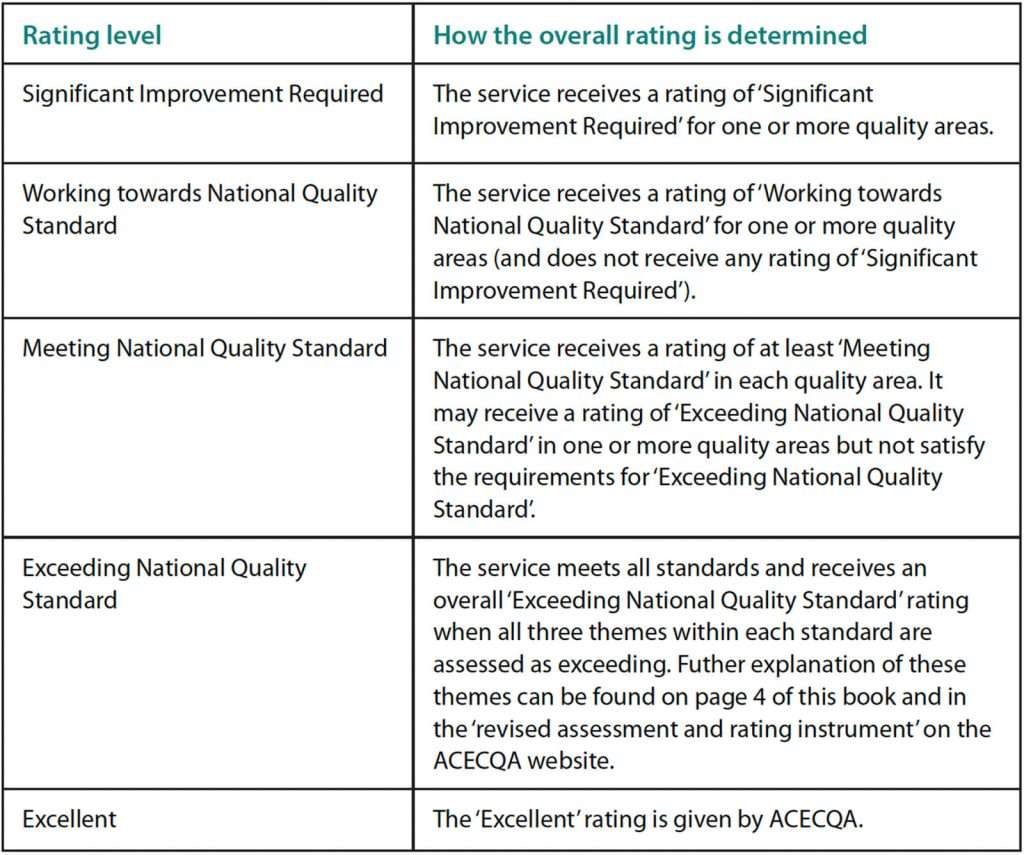
If your ECE is already rated Meeting NQS in all seven Quality Areas, you are well positioned to start the journey towards Exceeding NQS.
- To do so, you need to achieve Exceeding NQS in four of the Quality Areas.
- Two of these need to be in QA 1, 5, 6 or 7, with two other Quality Areas of your choosing. (ACECQA – Exceeding NQS)
Key shifts and focus areas in the 2026 NQS cycle
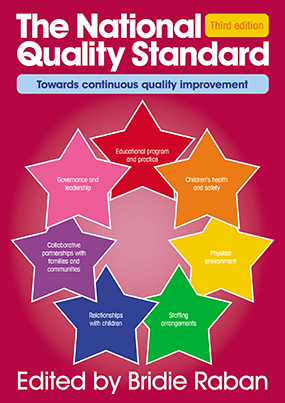
For a solid grounding in the NQS, it’s worth investing in a resource such as The National Quality Standard – Third Edition. Working through the resource allows you to break down the seven Quality Areas through a structured process of reflection questions, practical ideas and templates that you can copy and adapt to suit your own ECE preparations for assessment.
The upcoming assessment and rating cycle in 2026 brings some important refinements that services can prepare for now. Two key moves are especially relevant.
1. Child safety and rights become more central
From 1 January 2026, refinements to the NQS will enhance the focus on embedding child safety in practice through Quality Areas 2 and 7. (ACECQA – Child Safety)
For example.
- Element 2.2.3 (Children’s health & safety) will be renamed Child safety and protection, emphasising the educator and service role in identifying and responding to children at risk of abuse or neglect. (Queensland Government: Early Childhood Education and Care)
- In Quality Area 7 (Governance & leadership), new wording will explicitly reference child-safe services and embed this in governance systems. (Tasmanian Government: Education and Care)
- Changes already in effect from 1 September this year include safe-digital-technology policies, vaping bans, and shortened notification timeframes for abuse allegations. (Australian Government: Department of Education)
2. Continuous improvement and leadership move centre-stage
While the NQS has always emphasised continuous improvement, the 2026 cycle continues this trajectory.
- Strong educational leadership in early childhood, including critical reflection and embedded prior improvement work.
- For services aiming for Exceeding NQS, the rhythms of self-assessment, review, reflection and improvement become foundational – not optional.
What does this mean in practice?
- Make sure your child safety frameworks, digital use policies, supervision and incident management systems are up to date, robust and actively reviewed.
- Ensure leadership roles, such as educational leaders and coordinators are visible, supported and driving forward improvement cycles.
- Use the upcoming cycle to embed rather than bolt-on improvement plans, so that your Quality Improvement Plan (QIP) becomes a living tool, not just a submission.
- Keep families and communities in the loop. Transparency about improvement work, decision-making and partnerships will matter more.
Integrating the seven Quality Areas into everyday practice
The seven Quality Areas (QAs) of the NQS provide the lens through which services are assessed. Here’s a practical walk-through of each, with ideas for turning them into daily practice (ACECQA – National Quality Standard). By framing every day through these seven lenses, you build the habit of quality becoming lived rather than just stated.
QA 1 – Educational program and practice
- Use your approved learning framework (for example Early Years Learning Framework (EYLF V2.0) as the foundation for your curriculum decisions.
- Ensure each child’s current knowledge, culture, strengths and interests inform program planning (Element 1.1.2).
- Embed intentional teaching, responsive scaffolding and child-directed learning (Elements 1.2.1-1.2.3).
- Maintain a strong cycle of assessment → documentation → planning → implementation → reflection (Element 1.3.1).
Daily tip: Build short reflection pauses for educators. At the end of day, ask “What worked?”, “Why?”, and “What next?” to embed critical reflection.
QA 2 – Children’s health and safety
- Review health, hygiene, sleep/rest routines, incident/emergency plans and supervision.
- With the 2026 changes, strengthen systems for identifying children at risk, ensuring child-safe protection is front and centre.
Daily tip: Hold a short weekly team check-in on safety and supervision, review any near-misses, and ensure correction plans are logged.
QA 3 – Physical environment
- Make sure indoor and outdoor spaces, fixtures, resources and furniture support play, exploration and inclusion.
- Use the environment as the “third teacher.” Promote open-ended materials, multiple uses and natural elements.
Daily tip: Rotate materials weekly and set up an environment check roster for educators to pro-actively monitor maintenance and resource relevance.
QA 4 – Staffing arrangements
- Ensure continuity of educators, appropriate educator-child ratios and collaborative professionalism.
- Educational leader and coordinator roles need to be clearly defined and operational.
Daily tip: Hold fortnightly professional conversations that link back to your QIP and individual development plans.
QA 5 – Relationships with children
- Focus on respectful, responsive and engaged interactions. Consider children’s agency, self-regulation and peer relationships.
Daily tip: Use anecdotes and documentation of children’s decisions, self-regulation episodes and collaborative peer work to evidence practice.
QA 6 – Collaborative partnerships with families and communities
- Engage families as partners in decision-making about their child’s learning and wellbeing. Respect culture, values and beliefs.
- Transition practices, inclusion and community linkages matter.
Daily tip: Schedule monthly family check-ins, such as quick surveys or informal chats. Triangulate this data into your self-assessment.
QA 7 – Governance and leadership
- Your service philosophy, management systems, defined roles and responsibilities, and effective continuous improvement all come under this area.
Daily tip: Embed your QIP into governance meetings, make continuous improvement a standing agenda item, review outcomes and next steps at each session.
Preparing for your service’s NQS assessment in 2026
12–18 months ahead
- Review your latest assessment and rating report – identify Meeting vs Exceeding gaps.
- Ensure your QIP is robust, actionable, and aligned to all seven QAs, not just one.
- Review leadership capacity. Is your educational leader supported? Are staff professionally learning and progressing?
- Begin a review of your child safety systems and update policies in line with upcoming refinements.
6–12 months ahead
- Conduct internal audits or mock assessments of each QA: use service-specific evidence and triangulate data such as observations, surveys and documentation.
- Engage families and community partnerships as stakeholders in your reflection: ask for feedback and involve them in transitions and partnerships.
- Ensure your documentation – programs, learning stories and reflection cycles, are current, accessible and clearly linked to outcomes.
- Monitor the environment, resources and maintenance. Ensure nothing appears neglected ahead of your visit.
3–6 months ahead
- Review the regulatory changes and ensure policy implementation, such as digital use, supervision and incident management.
- Collate evidence of continuous improvement. Show how you have moved from Meeting to Exceeding via strategies, monitoring and review.
- Prepare a story of continuous improvement for each QA. What was the baseline? What did you implement? What was the impact?
- Schedule a team-wide session to reflect on the service’s strengths and next improvement cycle. Keep it active, not retrospective.
0–3 months ahead
- Review your evidence folder. Is it accessible, organised by QA, with clear signposts?
- Prepare your team for the assessment visit. Ensure everyone knows their role, can speak to evidence and feel confident.
- Communicate with families. Let them know the journey, invite input and showcase your improvement journey.
- After the visit, ensure there is a plan for follow-up, including embedding any feedback into your QIP for the next cycle.
Learning from services across Australia with Exceeding NQS rating
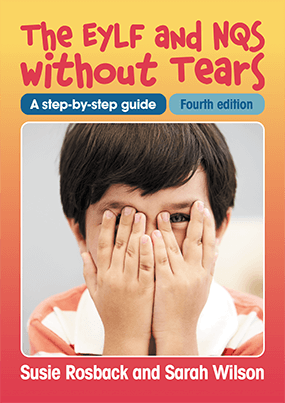
While many centres aim for the Exceeding NQS rating, it’s worth digging into what services actually do when they achieve this. Resources such as The EYLF and NQS without Tears draw on interviews and case studies of services rated Meeting NQS and Exceeding NQS, and show the difference that lies between the two. Here are two examples.
“We believe we maintain a “high” quality standard service, which was reflected in our QA5 interactions with children … It is very difficult when you have dedicated 20 years of your life to providing quality kindergarten to a community to only receive “meeting the standard”. We had hoped this would be a celebration of all we do, but after reflection and some time to lick our wounds, we will strive to exceed the standard and improve on any [of] the required areas.”
Toni, Kindergarten – Meeting National Quality Standard
“We are continuing to engage [the] new volunteer parent committee each year with the QIP, policies, procedures, philosophy and practice. This can feel exhausting and repetitive for the director/educational leader who does this, but it is important for each parent group to know these elements of the centre well, as they are, for their year on the committee, the approved provider.”
Leanne, Kindergarten – Exceeding National Quality Standard
Key themes from these high-performing services include:
- Leadership that drives and mentors improvement rather than simply managing compliance.
- A culture of educator inquiry: adaptive, reflective practice that evolves based on observed outcomes.
- Explicit partnerships with families and communities – not just communication, but co-creation of learning and transition experiences.
- Evidence of sustained improvement in practice, not just short-term fixes.
- Clear demonstration of how the service draws on research, theory and external benchmarking to inform practice.
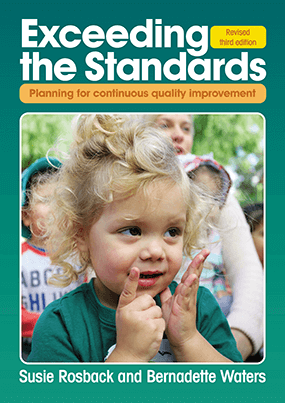
For those looking to begin the journey from Meeting to Exceeding, Exceeding the Standards: Revised third edition clearly demonstrates the difference between the two ratings, and provides a pathway to exceed for each Quality Area through simple checklists, tables, and tried and tested solutions used by exemplar services.

By implementing resources such as these alongside your own service’s records, you position your team to go beyond compliance and become educational leaders.
Final thoughts on Exceeding NQS
Exceeding the NQS in 2026 isn’t about chasing a badge – it’s about embedding quality, reflection and leadership into the day-to-day fabric of your service. By understanding the purpose of the NQF and staying ahead of the key shifts – especially around the most recent changes for child safety and continuous improvement, your service is well placed to do well.
Try to operationalise the seven Quality Areas as ongoing areas of growth rather than tasks to complete. Prepare thoroughly for assessment and rating – and you should see your service move up the ratings.
The journey of continuous improvement is relational, reflective and iterative. It’s about children, educators, families and communities working together to create meaningful learning and care experiences. Let 2026 be the year you lead with intent, reflect with purpose and grow with confidence.
References
Australian Children’s Education & Care Quality Authority (ACECQA). Child safety – NQF
Australian Children’s Education & Care Quality Authority (ACECQA). Exceeding NQS
Australian Children’s Education & Care Quality Authority (ACECQA). Guide to the National Quality Framework (NQF).
Australian Children’s Education & Care Quality Authority (ACECQA). Meeting NQS
Australian Children’s Education & Care Quality Authority (ACECQA). National Quality Standard
Australian Government Department of Education. New regulatory changes take effect
Queensland Government. Early Childhood Education and Care
Tasmanian Government. Education and Care