Creative arts play a vital role in promoting language development in early childhood. By integrating storytelling, drama, music and visual arts into the curriculum, educators can enhance children’s creativity, communication skills and vocabulary. These activities not only foster cognitive and emotional growth but also enable children to explore and express their individual identities. The sensory and hands-on nature of creative arts engages young learners in ways that traditional methods may not.
According to the EYLF, literacy is ‘the capacity, confidence and disposition to use language in all its forms’. This includes written, oral, visual and auditory communication. It acknowledges that literacy includes music, dance, storytelling, visual arts and drama, as well as talking, listening, reading and writing.
Read on to explore a selection of creative arts activities for kids that nurture language development in early childhood.
How creative arts enhance language skills in young children
Creative arts greatly benefit a child’s holistic development as they enable children to practice language skills and other connected disciplines.
Firstly, visual arts and vocabulary building are interlinked. Activities like drawing, painting and sculpting introduce children to new words related to colours, shapes, textures and materials. Meanwhile drama and dance introduce a wide range of vocabulary associated with emotions, actions and settings.
Creative arts often involve storytelling, whether through role-play in drama, illustrating stories in visual arts or composing song lyrics. Storytelling is a fun and engaging way to promote language development in early childhood. For example, as an educator or caregiver telling a story, we are modelling:
- a range of vocabulary
- specialised knowledge
- correct pronunciation
- full sentences
- singular and plurals
- pace
- tone
- tense
- responding to words and ideas [Soper, 2023]
Furthermore, stories help children understand narrative structures, sequence of events and character, fostering a lifelong enjoyment and appreciation of literature.
Crucially, the creative arts equip children with visual, written and oral languages that enable them to express themselves. The arts also allow children to explore their real-life experiences and engage with events that are worrying them. For example, using drawing to process a new sibling, going on a holiday or a natural disaster [Te Whāriki]. Through these activities, children gain the tools they need to navigate their world and communicate their inner lives to others.
As well as language skills, the creative arts also overlap with other subjects such as science and maths. The authors of Developing Early Maths through Story explain that mathematics and storytelling have lots in common. Just like storytelling, mathematics is also a way of making connections between objects and events in the real world. Similarly, music and dance often involve recognising and creating patterns which are fundamental concepts in mathematics.
Plus, many creative arts activities are collaborative in nature, requiring children to work with peers and adults. This enables them to practice social skills and exercise emotional intelligence by sharing resources, considering others and asking appropriate questions. Drama games can be especially helpful for this. By assuming a character and interacting with others, children learn to understand different perspectives (Harries, Raban, Margetts, 2011).
Additionally, creative arts can introduce children to various cultures and foreign languages. This helps them grow into empathetic and culturally informed citizens. For suggestions of creative arts activities that explore religious and cultural festivals, dip into Multicultural Celebrations and Festivals.
Effective creative arts activities for language development in early childhood
Creative arts activities are a great way to engage children’s senses and imagination. This multisensory approach to learning makes language acquisition more enjoyable and effective.
Outcome 5 of the EYLF V 2.0, children are effective communicators, is founded on the belief that communication is key to being, belonging and becoming. Outcome 5 recognises the important role of creative arts in literacy learning. To support children’s language development and communication skills in line with Outcome 5, educators can:
- build on children’s family and community experiences with creative and expressive arts
- offer a range of resources that enable children to express meaning through visual arts, dance, drama and music
- ask and answer questions during the reading or discussion of books and other texts
- provide resources that encourage children to experiment with images and print
- teach children skills and techniques that will enhance their capacity for self-expression and communication
- join in children’s play and co-construct materials such as signs that extend the play and enhance literacy learning.
The following activities are designed by expert educators to delight and inspire children while furthering their language skills!
Embedding language in dance
These fun prompts offer suggestions on how to incorporate language into dance activities:
- use concepts and words (eg, nature, home, science) and invite children to ‘dance’ how these words look and feel
- use movement and poses to tell a story eg, ‘move your body like a petal caught in the wind … you are lifted up and down, side to side, and float slowly down to the ground.’
- Use movement to represent an object eg, ‘you are making a very tall building, with straight, flat windows, and a big door at the bottom that opens and closes.’
- use dance as an opportunity for children to develop a sense of self and others by sharing spaces and objects [Source: Victorian Government]
Fixing Humpty Dumpty
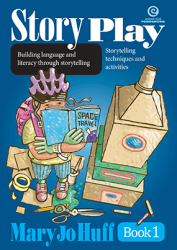
Inspire a love of literature and strengthen children’s communication and sequencing skills with the activities in Mary Jo Huff’s Story Play series. The following activity uses a well-known nursery rhyme to recognise rhyming words.
Materials
- sticking plasters
- markers
- one large piece of red poster board
- Storyboard
- two large pieces of white poster board
- Velcro hook tape
Humpty Dumpty
Humpty Dumpty sat on a wall.
Humpty Dumpty had a great fall.
All the king’s horses and all the king’s men
Couldn’t put Humpty together again.

Preparation
- Cut the red poster board in half and use the markers to draw lines to make it look like a brick wall. Print the names of the children on the bricks.
- Cut a large oval from one piece of white poster board and create a face on it using the markers.
- Cut another large oval from white poster board, create a similar face and add lots of cracks.
- Put Velcro hook tape on the backs of the pieces.
What to do
- Gather the children around a Storyboard and use the nursery rhyme to tell the children the story of Humpty Dumpty using the props you made.
- When you are finished with the story, have each child choose a sticking plaster and use a permanent marker to print their name on it (offer help as needed).
- Have the children put their sticking plasters on the cracked egg to help put it “together again”.
Reviewing what the children learnt
Ask individual children the following questions:
- What happened to Humpty Dumpty in the poem?
- Why do you think Humpty Dumpty was sitting on the wall?
- Have you ever worn a sticking plaster? Why did you need it?
Restoring the Rainbow
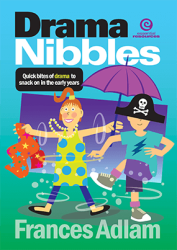
Nurture creative expression in your early years setting with drama and role-play games. These activities help children to express their emotions and hone their communication and language skills. The following activity from Drama Nibbles requires children to work together to help a rainbow fairy.
A letter arrives for the children. It is from the “rainbow fairy”. It tells the children that the mean black and white goblin has stolen all the colours from the rainbow. Is there any way they can help? The rainbow fairy suggests they look around the indoor and outdoor space and find something for each colour of the rainbow: a red bucket, an orange hoop, etc.
The next day another letter arrives from the rainbow fairy. She says that she has brought a large piece of paper to the pre-school and she wants the children to paint all the colours of the rainbow on it. Then she will make some rainbow magic happen.
Get the children to paint all the colours of the rainbow on the large piece of paper – with fingers, sponges or paint brushes. You could add a message from children to the fairy, on the paper.
The next day a letter arrives from the black and white goblin. He says that the world would be fine with no rainbows. In fact, he does not think colour is very useful.
Send the children on a colour hunt. They find all the things they like, indoors and outdoors, and note down the colours (by using crayons, pencils or paints to squiggle the colour on a piece of paper). They think about what the world would look like without colours. They explore and discuss why some things have colours – flowers so the insects can find them, paint to decorate walls and buildings, etc.
The next day a letter from the rainbow fairy arrives. She thanks the children for noticing all the colours in the world, and thinking about why they are so wonderful, and sometimes useful. She tells the children that because of their help she will be able to create the rainbow magic over night.
The next day the children come back to a large paper rainbow and thank you note from the rainbow fairy.
Ask the children if they want to design something colourful for the black and white goblin so he can enjoy colour too. Perhaps they leave out a colourful treasure box for him. It could include colourful clothes, flowers and grass from the garden, and some of the children’s paintings.
If you’re in need of inspiration for more fun drama activities, make sure to look at Stepping Stones to Drama and Role Play.
Last thoughts on language development in early childhood
In conclusion, creative arts play a pivotal role in supporting language development in early childhood. Storytelling, drama, dance and role-play significantly boost vocabulary and communication skills in young children. By creating a literacy-enriched environment and engaging children in imaginative scenarios, educators can nurture creative expression in early years settings. For more advice on enhancing language skills through creative arts, check out Dance Nibbles Book 1 and Stepping Stones to Stories Songs and Rhymes.
References
Performing arts (interacting with others). (2023, November 22). www.vic.gov.au; Victorian Government.
Soper, R. (2023). EARLY LANGUAGE DEVELOPMENT. Early Childhood Australia.