We are all familiar with assessment of learning as an activity to discover children’s current progress in their learning, development and wellbeing. We also use assessment for learning to guide our plans for continuing to support children’s understandings of the world they live in. Our documentation and planning help us to keep track and to refine and guide further activities for both individual children and groups who share similar levels of understanding. Here I focus on a third broad type of assessment that features in the recently revised Early Years Learning Framework (EYLF) – assessment as learning.
Assessment as learning in the revised EYLF
Australian families have a rich diversity and many life experiences. Children bring these with them to early childhood settings, which makes the role of the educator both complex and rewarding. The revised EYLF builds on the notion that children bring a wealth of knowledge and understandings from their home. But also their community and their culture. Like its predecessor, it recognises and acknowledges children as capable and competent learners who have rights and agency. One of the rights that it draws attention to is the right to be engaged in and contributing to the assessment of their progress through the early years.
Assessment as learning is seen as an opportunity for educators. An opportunity to plan for, facilitate and encourage children’s awareness of their learning. Thus helping them to see their own role in their progress. Further, it develops children’s awareness of their learning and how it is increasing their skills, understandings and abilities within the worlds they inhabit.
These are desirable outcomes to aspire to. So how can we engage children meaningfully in the assessment process in order to realise them in our practice?

Practice 5: Assessment and evaluation for learning, development and wellbeing
The revised EYLF offers a pathway towards assessment as learning with Practice 5. This is one of its eight practices. Assessment and evaluation for learning, development and wellbeing is an ongoing activity. It cycles between observations, critical reflections, planning, evaluating outcomes and fine tuning directions and activities. This happens through discussions with children, family members, colleagues and other professionals. It is supported by documentation and interactions with the children as their learning, development and wellbeing progress.
Floorbooks and assessment as learning
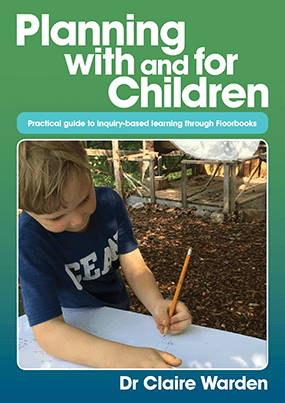
Claire Warden’s book Planning with and for Children (2021) gives a practical view of how educators can use Floorbooks® in inquiry-based practice. This engages children in their own learning. Floorbooks are large books, left open on the floor, to which a number of children and their educators contribute. Given much conversation emerges from the questions children ask, contributions to the floorbook present opportunities to explore different answers. This happens through drawings, photographs, displays of ideas, and shared conclusions. Children can return to these pages again and again as their understandings of their enquiries develop and change. They can also add fresh ideas over time.
Note that when you scribe for children, you need to record exactly what they say. This is how children will ‘read’ the text when they return to it.

Portfolios
Another opportunity for collating evidence collaboratively comes through portfolios. Each child can contribute to the development of their portfolio by deciding with educators which samples to include to celebrate their learning journey. Samples may include:
- pieces of art work
- records of their ideas or preferences
- models
- photographs
- artifacts
- descriptions of episodes
- items from home that families provide.
However, portfolios are different from scrapbooks or records of memoirs. This is in that they encourage a comprehensive and in-depth reflection on the journey from a holistic perspective over time, as well as validating forward planning.
Children also need to contribute to the documentation that makes up their portfolio. This will give the documentation an element of authenticity as educators learn more about these experiences from each child’s perspective.
Documentation methods of assessment
Using a variety of methods of documentation will help educators build up a holistic picture of each child. Similarly it helps to vary the times when you document and the experiences you cover, both indoors and outdoors. Some methods are more suited to particular circumstances than others. You will need to discuss your choices and decide on them with colleagues and the children.
In some circumstances, you may decide to collect evidence randomly. This has the aim of gaining a view of what each child accesses and enjoys with you and with different groups of their peers. To gain a truly holistic view of the child, however, it is likely that you will need to plan some collection activities in order to capture certain skills. For instance, at the start of a new activity, it may be appropriate to document how the child approaches experiences. Include their views on the experiences they had with others or when they were alone.
My conclusions on assessment as learning
By viewing and recording children’s activities from a range of different perspectives, including those of the children themselves and their families, along with those of other professionals, you can reflect on young children’s progress and share with them options for further activities they can explore. Although activities that children choose might seem arbitrary, in reality they are of vital significance to the child or children involved. The relevance of such choices may well be lost if children are not involved in the process of assessment as a continuing opportunity.
References
Australian Government Department of Education (2022) Belonging, Being and Becoming: The Early Years Learning Framework for Australia (V2.0). Canberra: Australian Government Department of Education for the Ministerial Council. URL: www.acecqa.gov.au/sites/default/files/2023-01/EYLF-2022-V2.0.pdf (accessed 31 March 2023).
Warden, C (2021) Planning with and for Children: A practical guide to inquiry-based learning through Floorbooks®. Strawberry Hills, NSW: Teaching Solutions.
About Bridie Raban
Bridie Raban was the Foundation Mooroolbeek Professor of Early Childhood Studies at the University of Melbourne. She is currently an Honorary Professorial Fellow at the Melbourne Graduate School of Education and in 2021, she was awarded an Honorary University Fellowship by Hong Kong Baptist University (HKBU). Her past research has focused on language and literacy development, teacher change and development, curriculum and assessment for the early childhood years and quality provision. She was the first Professor of Early Childhood Education in Victoria and the second in Australia, and before this she was Professor of Primary Education (Early Years) at the University of Warwick and President of the UK Reading Association.