Capacity & volume
- Young children need no encouragement to fill and empty boxes and containers. Offer them containers made from different materials that make a surprising sound when you drop an object in. Model the words “full up”, “all gone” and “no more” as they play. Can they guess in advance how many items it will take to fill the container?
- Put out a rain gauge or a jar with straight see-through sides. Every day, inspect how much water is in the gauge and make a mark on the side to show where the water is up to. How many days before the jar is full?
- Give each child a bucket and ask them to stand in a long line. Pour water into the first child’s bucket and ask them to pass the water down the line, from one bucket to the next. Ask the children about the amount of water left in the last bucket.

Weight
- Provide sponges for children to compare the dry and wet weight.
- Bury metal coins, plastic coins, glass gems, plastic jewels and costume jewellery and provide weighing scales for children to weigh and compare their finds.
- Ask the children to form a very large circle. Stand in the middle, pick out an object, hold it up in the air and drop it. Watch it descend and land then ask the children if they can describe how it fell. Could they tell from watching how the object moved whether it was heavy or light? Repeat with the other objects. Ask the children to spread out and find a space. Tell the children that you are going to call out the name of an object. Ask them to think about whether it is heavy or light and then move like the object would if it was thrown in the air.
Time
- Provide sand timers and ask, “Who can build the tallest tower before the sand runs out?”
- Display a pictorial ‘Day in the life of a builder’ on an easel. Include pictures of builders arriving at work, working, taking tea breaks, having lunch, receiving deliveries and going home.
- Provide bottles with different sized holes in the bottom and jugs and watering cans with different spouts and sprinklers for children to use to experience fast and slow flow.

This article was based on content from these popular Essential Resources titles:
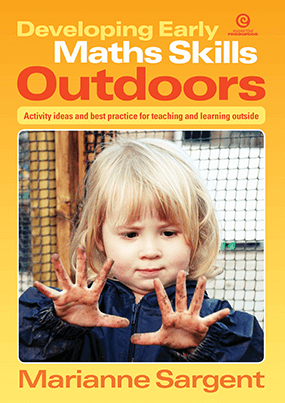
- Developing Early Maths Skills Outdoors by Marianne Sargent
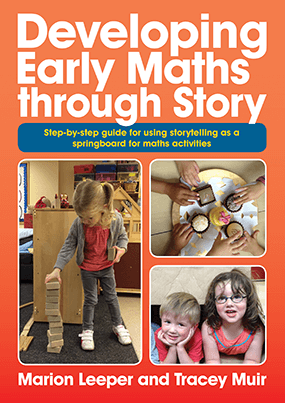
- Developing Early Maths through Story by Marion Leeper and Tracey Muir
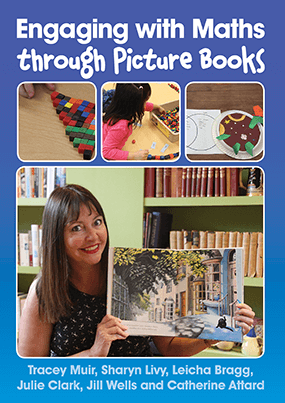
- Engaging with Mathematics through Picture Books by Tracey Muir, Sharyn Livy, Leicha Bragg, Julie Clark, Jill Wells & Catherine Attard
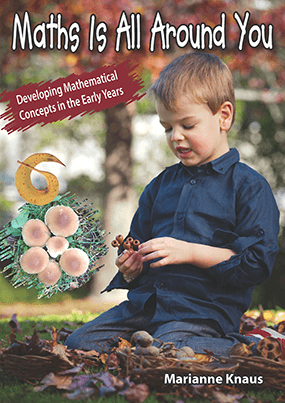
- Maths is All Around You by Marianne Knaus
For more on teaching maths in early childhood, see Marianne Knaus’ article Using incidental opportunities to talk about maths and our other articles on mathematical concepts.
References
Booker, G., Bond, D., Sparrow, L. & Swan, P. 2010. Teaching primary mathematics (4th edn). Sydney: Pearson, Australia.
Van de Walle, J.A., Karp, K.S. & Bay-Williams, J.M. 2013. Elementary and middle school mathematics: Teaching developmentally (8th edn). Upper Saddle River NJ: Pearson.