A WHITE PAPER BY DR CHRISTINE BRAID

A literacy programme supporting learners to achieve reading success

Dr Braid is an education practitioner and researcher with 40 years of experience across classroom teaching, professional development with teachers, and research in the area of literacy.
Abstract
It can be difficult for teachers to find texts that are specifically designed to support students who are not reading at their year level or have a language background other than English (ESOL students). To improve their reading skills, all students need to have access to texts at a level that they can read without becoming frustrated.
Recognising that ESOL and a range of other students need support before they can access texts at their year level, this white paper examines how specifically controlled texts can enable these students to feel successful as readers and to practise reading skills that enhance their reading capability.
The Story Seekers series, published by Essential Resources, provides texts that are both accessible and knowledge enhancing, with content that suits the age of the reader. Rather than replacing the use of year-level texts, this series provides an important bridge to them so learners at all levels of ability, including ESOL learners, can continue to develop their reading skills.

The problem
Students who are still developing their ability to read year-level texts have limited choices of alternative, high-quality texts that allow them to experience success with reading. As a result, they do not get to practise decoding skills or gain mileage in reading connected text – skills that will be expected of them through later primary and into secondary education. A lack of opportunity to engage successfully with print contributes to a lack of progress in reading. This cyclical pattern is an example of the Matthew Effect (Stanovich, 1980), which describes how reading capability declines among those with less effective reading skills while it improves among those with advanced reading skills.
A parallel problem faces teachers who are wanting to give developing readers the chance to read texts at a level that is not frustrating for them. Teachers seek cross-curricular texts that help students build background knowledge and grow their vocabulary. Ideally such texts would also support teachers to develop their students’ confidence, motivation and satisfaction as readers. Until recently, however, teachers have been constrained by the dearth of top-quality publications in this area.
The solution: The Story Seekers series
The Story Seekers series, published by Essential Resources, is designed to provide much-needed texts for students who would otherwise have limited access to materials that support their reading development. Without such supportive texts, students could be held back in developing their reading capability.
The series is grounded in extensive research and development that began in 2015, led by Helen McEwen of Essential Resources. As an initial part of the process, Helen sought advice and feedback from Professor James Chapman and Dr Christine Braid of New Zealand’s Massey University, as well as from Adele Hibbs, a reading specialist for dyslexia.
From the start, the aim was to produce chapter books specifically designed for readers aged 8–12 years who are not making progress with the texts expected of their year level, as well as for students with a language background other than English (ESOL), to help fill the gaps in their literacy knowledge. Using this reading material, teachers could support these students to experience success in their reading.
The resulting Story Seekers series gives teachers two levels to choose from. Series 1 and 2 are designed to appeal to the interests of students aged 8 to 11 years while at an instructional level they are suited to students who can cope with materials aimed at those aged 6.5 to 7.5 years. Series 3 caters to the interests of those aged 9 to 12 years who are at an instructional level of 7.5 to 8 years.
Supporting readers
Success in reading requires capability in word recognition/decoding as well as understanding of language in its spoken form, according to the Simple View of Reading (Gough & Tunmer, 1986). The Simple View of Reading defines reading success as well as identifying what can contribute to reading difficulty. Students with reading difficulty and ESOL learners could have issues either in decoding or in understanding language, or in both components, as illustrated in the shaded areas of Table 1. The Story Seekers series is designed to develop capability in both decoding and language comprehension.
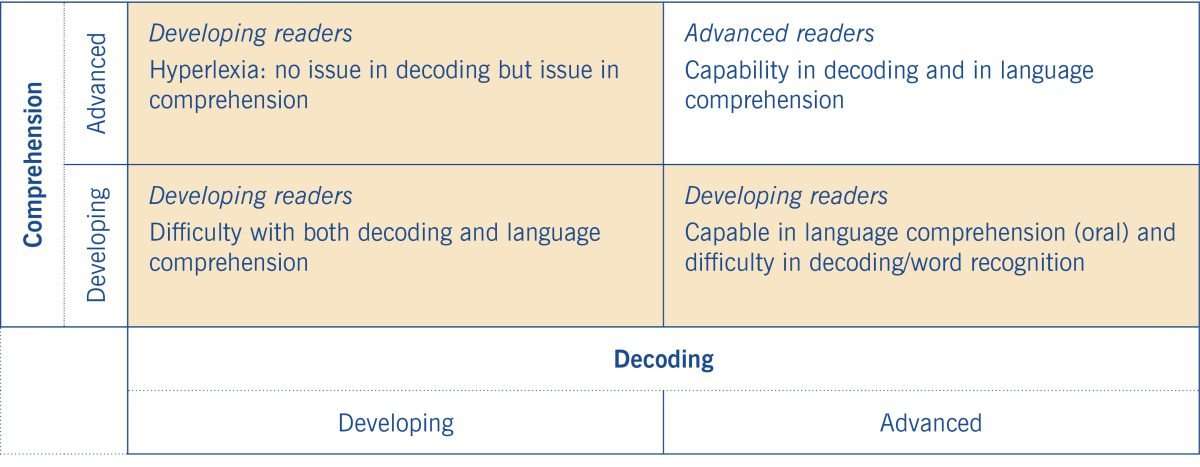
The series is designed to support students’ development in decoding words, including multisyllabic and technical words. It is also planned to develop wider vocabulary, understanding of sentence structure, and reading for meaning and understanding. Each book is controlled for the features that are important to strengthen reading skills at its focus learning level.
Controlling for decoding demand
The Simple View of Reading is clear that word recognition or print processing is vital to reading comprehension. Morris et al (2019) suggest that print processing can be seen as a kind of “engine” with power that must increase steadily over the primary years if readers are to handle the increasingly complex texts that confront them. An important factor in increasing print-processing capability is that students have access to text that they can decode relatively easily.
Aiming for reading success rather than frustration
Reading rate is important because it affects the amount of attention required to complete reading tasks. LaBerge and Samuels (1974) describe reading as a “zero-sum” game, in which a reader must divide their finite amount of attention between word recognition and comprehension. If they can automatise word recognition, the reader can devote maximum attention to comprehension (Hoover & Tunmer, 2020). Certainly, where students encounter any text at frustration level, they are likely to read it very slowly and without a helpful degree of comprehension.
Conversely, controlling material for reading difficulty has a long and effective history in teaching. Morris (2014) found that instruction was most successful when students can read the text with adequate accuracy (95%) and comprehension (75%), and at a reasonable fluency rate. Making between 5 and 10 errors per 100 words is the ideal used for the instructional level in most present-day reading textbooks and diagnostic inventories (Allington et al., 2015). It is certainly clear that frustration-level texts should be avoided and that, even if a teacher can support students to read a text at this level, the long-term benefits of being able to read a text independently are significant. It is noteworthy that the students who are reading below the expected year level have the greatest need for text at instructional level (Morris et al., 2019).
Those advocating for use of difficult text (Shanahan et al., 2012) are concerned that controlled texts limit learners’ experience to short texts, short sentences and mainly common rather than rare words. From this viewpoint, these features slow students’ reading growth and reduce their capability to read texts they need to be able to access.
Taking on board these issues, the Story Seekers series offers longer texts that include medium-length sentences along with shorter ones, and many new and rare words within a controlled context.
Addressing readability
It is vital that all students, including those who have reading difficulty and ESOL learners, get access to year-level texts. Teachers can support access to year-level texts even for students whose decoding is lower by providing scaffolding, such as pre-teaching vocabulary, and providing opportunities to listen to recorded text or to other students reading aloud. These strategies suggest that differentiating instruction by student reading level may not be necessary (Shanahan, 2014).
While the instructional strategies a teacher uses might help to improve learners’ content and vocabulary knowledge and increase their interest in the text, they will not strengthen print-processing capability because they do not engage the learners in reading independently (Morris et al., 2019). Research shows clearly that those students who are below their year level with reading need text that helps them improve in print processing so that they can advance with comprehension. Without strengthening their independent print-processing capability, these readers will be disadvantaged.
One way to support students to progress in their reading is to control the difficulty of the text. The control can be applied to the decoding demand or to the sentence and vocabulary demand or to both. The levelled system of the Story Seekers series takes account of the decoding and the language comprehension parts of the Simple View of Reading.
Although individual readability formulas tend not to provide exact analyses, using a combination of methods helps to match student capability to text challenges as closely as possible. The Story Seekers books have been analysed using three readability tools: Flesch reading ease, Flesch-Kincaid grade level and Fry graph. In addition, a consensus readability level is established based on seven tools available online through Readability Scoring System Plus.
Controlling for language demand
Vocabulary knowledge is important to both decoding and comprehension. It is easier for learners to decode a written word that is in their spoken vocabulary than one that is not. This relationship is particularly evident when a student’s attempt at decoding might result in an incorrect pronunciation or emphasis on the wrong syllable. If the word is in the reader’s known, spoken vocabulary, they can flex the vowel or emphasis to make the word sound like the word they know. It is also easier to understand a text when the reader has access to the meaning of most of the words, compared with a text in which they are confronted by too many words of unknown meaning to them.
Developing knowledge of tier two and tier three words
Among the design factors to consider in deciding which words to use in a text are the decodability of each word and the knowledge a student is likely to have of it. Vocabulary can be categorised as tier one words (everyday words), tier two words (book and academic language) and tier three words (technical words needed for a particular topic). ESOL learners will benefit from encountering tier one words they can practise in the context of sentences. In addition, all students will need tier three words to access topic knowledge. It is tier two words that often confuse learners because these words may have different meanings in different contexts and may not be words they experience frequently in everyday interactions. Yet knowledge of tier two words is important for advancing students’ capability in comprehension (Beck et al., 2013).
Story Seekers can be used to develop knowledge of words at both tiers two and three. The books also break longer tier three (topic-specific) words into syllables and phonetic spelling to show how to read them. Once a student has heard the word, they can match its orthographic patterns to its pronunciation. The process of hearing the word, decoding it and reading it again is important to orthographically mapping it.
At first glance, tier two words might seem relatively rare in Story Seekers because the vocabulary has been carefully selected to be accessible to ESOL students. But on closer examination, many words in this series are useful tier two words. In Amazing Animal Journeys (Philippa Werry, Series 3, Book 6), for example, words such as season, cover, plain, journey and cross could be worth explaining to students. Students newer to English learning may know cover in one context – as the cover (noun) of a book – but the book shows how animals cover (verb) a plain. Similarly they might know cross (noun) as a symbol but not as a verb for going over a river. The potential to extend tier two vocabulary is evident in the fictional texts too. For example, the teaching notes in Mysterious Lights in the Night (Dawn Macmillan, Series 2, Book 16) suggest examining the statement “They are no accident” with a focus on what accident means in this context.
Controlling sentence length and complexity
Simple sentences with a basic subject–verb structure create minimal cognitive load. In complex structures such as subordinate and relative clauses and longer sentences that include embedded phrases, it is harder to keep track of key parts of the sentence and the relationships between them such as who did what to whom.
Story Seekers is intentionally controlled for sentence length and complexity. In Series 1, most sentences are simple and relatively short, enabling learners to focus on decoding and the content. Floating on Air (Paul Mason, Book 2), for example, controls sentence length and complexity to recount some astounding balloon flights while maintaining the sense of drama. This is evident in the story of an escape from East Germany:
They took off into the dark.
The balloon climbed high. The wind carried them on.
In Series 2, both the length and structural complexity of sentences increase but the books still contain many short sentences. A challenge for the reader now is to work out how a subject and verb are related to other parts of the sentence. Consider this sentence in Mysterious Lights in the Night:
He watched his friend Tom drawing circles without making any mistakes.
To understand this sentence, the reader needs to think through who is watching his friend, who is Tom, who is drawing circles and who is not making any mistakes.
The challenge increases further in Series 3, which is important because many of the year-level texts will include complex and/or longer sentences. For example, What’s Up with Gravity? (Heather Haylock, Book 19) contains the following complex sentence, with an introductory subordinate clause before the main clause.
If a pencil breaks, the little bits of it can float away and hurt an astronaut.
The main clause has a subject phrase (the little bits of it) and a compound verb phrase (can float away and hurt an astronaut).
In all Story Seekers books, the sentences remain as two clauses rather than three or more. The control of sentence length and complexity contributes to the greater readability of these texts and controls the cognitive load involved in reading them.
Other features of text
In addition to its language components to support reading and readability, Story Seekers has been carefully designed to make reading both more appealing and more accessible. Supporting features include an attractive layout, a font of an accessible size and style set against an appropriate background colour, well-spaced text, a consistent page count and a careful balance of text and images on each page. Tools like a table of contents, glossed words, pronunciation guides, sidebars and a variety of graphic features provide further guidance on how to read the text.
All of these features are intrinsic to Story Seekers and are important reasons why these texts support developing readers, including ESOL students.
Supporting readers
Effective teaching requires the right mix of teacher knowledge, teaching practice and teacher resources. A teacher who has good knowledge without the support of appropriate resources and practice will not teach effectively (Arrow et al., 2019). Similarly, merely having good resources will not be enough to provide good outcomes for learners. In turn, both knowledge and resources are necessary to enable best teaching practice.
Just as the Matthew Effect demonstrates that students with advanced reading skills build even better reading skills, the Peter Effect describes how literacy teaching improves when teachers understand the foundations of language. That understanding can come through teacher education when teacher educators pass on research-informed literacy knowledge.
Story Seekers likewise contributes to teacher knowledge of the foundations of literacy, so that teachers can be confident in the knowledge they pass on to students. The series offers three key forms of support.
First, all of the student books end with follow-up activities that teachers can use to enhance learning after the reading. That includes guidance on the phonics focus for each book, with a list of examples of related words in the main text that the teacher can draw to their students’ attention.
Second, the teacher edition of each text overlays the student version with supporting information for teachers. Each teacher edition includes notes on a suggested, adaptable lesson plan and a clear script that teachers can use to pass on knowledge related to the phonics focus. Throughout the teacher editions are suggested questions that teachers can ask when students are reading particular pages of the book. These discussion starters cover the fundamental aspects of reading success: vocabulary, comprehension and decoding. The notes are designed to encourage consistency in the way the series is used across different classrooms, while recognising that good teacher knowledge is also essential.
Finally, activity books are available to support teachers in creating effective lessons. Each activity book covers the release of a collection of texts within the Story Seekers series. It guides teachers to scaffold learning appropriately for the learners in front of them, while removing some of the burden of planning lessons that will work for the learners who need the most support. The teacher notes contain suggestions for teaching points pre-reading, during reading and post-reading and encourage teaching moves such as explicit teaching, guidance for students to use clues, suggested questions, and activities for students to apply their learning.
Conclusion
The Story Seekers series is an impactful resource carefully designed to include features that can be evaluated against important aspects of reading and teaching. Each student book is intentionally controlled and designed for accessibility, as confirmed by analyses with readability tools. The whole series is well positioned to support teachers to help both learners who have some reading difficulty and ESOL students.
With this series, students can read and work with material at an appropriate level to help them strengthen their reading skills and capability. In this way, they experience success in their reading rather than the frustration that comes with not understanding texts at their year level. Building on evidence that readers who need the most support will be disadvantaged without experiencing texts at their “just right” level, this series provides an opportunity for a genuine breakthrough in teaching and learning success.

References
Allington, R., McCuiston, K., & Billen, M. (2015). What research says about text complexity and learning to read. The Reading Teacher, 68, 491–501. https://doi.org/10.1002/trtr.1280
Arrow, A. W., Braid, C. L., & Chapman, J. C. (2019). Explicit linguistic knowledge is necessary, but not sufficient, for the provision of explicit early literacy instruction. Annals of Dyslexia, 69, 99–113. https://doi.org/10.1007/s11881-018-00168-0
Beck, I. L., McKeown, M., & Kucan, L. (2013). Bringing words to life: Robust vocabulary instruction. Guilford Press.
Gough, P. B., & Tunmer, W. E. (1986). Decoding, reading, and reading disability. Remedial and Special Education, 7, 6–10. https://doi.org/10.1177/074193258600700104
Hoover, W., & Tunmer, W. E. (2020). The cognitive foundations of reading and its acquisition: A framework with applications connecting teaching and learning. SpringerLink.
LaBerge, D., & Samuels, S. J. (1974). Toward a theory of automatic information processing in reading. Cognitive Psychology, 6, 293–323. https://doi.org/10.1016/0010-0285(74)90015-2
Morris, D. (2014). Diagnosis and correction of reading problems (2nd ed.). Guilford Press.
Morris, D., Trathen, W., Gill, T., Perney, J., Schlagal, R., Ward, D., & Frye, E. M. (2019). Reading instructional level from a print-processing perspective. Reading & Writing Quarterly, 35(6), 556–571. https://doi.org/10.1080/10573569.2019.1598311
Shanahan, T. (2014). Should we teach students at their reading levels? Reading Today, September/October, 14–15.
Shanahan, T. & Fisher, D., & Frey, N. (2012). The challenge of challenging text. Educational Leadership: Journal of the Department of Supervision and Curriculum Development, NEA, 69, 58–62.
Stanovich, K. (1980). Toward an interactive-compensatory model of individual differences in the development of reading fluency. Reading Research Quarterly, 16, 32–71.